
Forum Replies Created
-
AuthorReplies
-
It is debatable whether bubble wrap would be deemed as glazing. Glazing is the glass used for windows and is permanently installed. Bubble wrap is plastic, is a temporary installation rather than a permanent installation and is most likely to be taped onto the inside surface of the frame. As such it would be more akin to a curtain.
The bubble wrap could be being used for privacy or for insulation against the cold or for maximising the cooling potential of an air conditioner or for growing plants in the Lot.
https://www.builditsolar.com/Projects/Conservation/bubblewrap.htm
Perhaps the tenant can be approached and asked the reason for the bubble wrap. The tenant might be able to be directed to seek approval from the Owner of the Lot for a blind or a curtain if privacy is an issue.
Some By-laws contain a directive about curtaining or curtain backing being of a particular type or colour so check your by-laws to see whether this applies to your scheme.
The ‘devil’ is usually in the detail in these contracts. Perhaps next time that the contract is about to be renewed your OC can remove the clause that refers to commissions, or your OC can change it to reduce the amount of commission to a number that better suits your scheme’s circumstances.
If you hold all three executive positions then you have effectively been doing the job of the SM for free over all of the time prior to the employment of the SM. I wouldn’t be moving back to a self managed mode unless there are more willing and interested owners who will join the committee and share the load!
I would contact the SM again next week, when the SM should be back at work, about the Letter of Authority and the lack of response, and also reiterate the SM’s contractual boundaries and delegated duties.
Keep a record of any perceived performance transgressions and look again at the SM contract to understand the termination for ‘breach of duties’ provisions in the contract.
If things become ‘messier’ then you can also seek mediation through the OFT. Information from their site is below:
Dispute with a strata managing agent
The NSW Civil and Administrative Tribunal (the Tribunal) can make decisions about disputes with a strata managing agent.
Disputes are resolved at a Tribunal hearing if they are not resolved at mediation or determined inappropriate for mediation.
Only an owners corporation can apply to the Tribunal for an order to resolve a dispute with a managing agent about their agreement. The Tribunal, in dealing with such a dispute, can make the following orders:
- terminate an agreement
- require payment of compensation by a party to the agreement
- change, confirm or declare invalid the terms and conditions of the agreement
- dismiss the application.
The Tribunal may make an order to terminate an agreement due to:
- the managing agent’s unsatisfactory performance under the agreement
- unfairness of charges paid
- a strata managing agent not disclosing commissions or training services, or disclosing these in good faith
- the agreement being harsh, oppressive, unconscionable or unreasonable
- the managing agent not disclosing an interest, which led to them being appointed
This is not a particularly good start to your scheme’s relationship with the SM.
In my opinion …at first glance the SM appears to have over stepped his authority but this very much depends on what contract provisions that your OC approved and has signed with the new SM in their Strata Management Agreement.
Was the SM’s exclusive authority to seek out alternative insurance policies something that was agreed to in the SM’s contract? Check the contract.
What reasons were given for not being able to renew your existing policy, and were these reasons given by the insurance company or the new SM?
I would have thought that the Committee would also have the authority to also seek out quotes for insurance. After all, any owner has a right to seek out quotes that can then be submitted by that owner as a Motion at general meetings. This will no doubt generate animosity with your new SM which is something that you may not want.
https://www.lookupstrata.com.au/nsw-duties-of-strata-treasurer/
supersleuth – In my opinion you would be correct in your assessment.
I wish that I could advise Lot A that they a better chance of success than they hope for, but unfortunately I cannot do so.
Lot A must prove that the Body Corporate has been “unreasonable” in its decision making. To date the Body Corporate have made no “unreasonable” decisions regarding this matter. Whether the owner of Lot B is being “unreasonable” is not within the jurisdiction of the Act or the Tribunal to determine.
An exclusive use right is a valuable right and one that is extremely difficult to remove from an unwilling party. https://www.qld.gov.au/law/housing-and-neighbours/body-corporate/by-laws/exclusive-use-by-law
The exclusive use boundaries have not ever been changed therefore they do not need to be “restored”. Lot B is perfectly within their rights to have full use and enjoyment of all of their exclusive use area.
I am not of the same opinion as JT that a fence between two exclusive use areas in Qld would require a resolution without dissent. Perhaps JT is referring to NSW legislation which is possibly quite different.
Lot B was obviously aware of the boundary when they purchased their Lot. It is very unfortunate that Lot A purchased their Lot without being fully aware of the boundary of the allocated exclusive use area.
There are three ways in which such a fence can be approved in Qld: (1) via the Neighbourhood Disputes (Dividing Fences and Trees) Act 2011 and the requirements that a sufficient dividing fence be erected on a boundary should one owner request it and with both owners sharing the cost (see https://www.qld.gov.au/law/housing-and-neighbours/disputes-about-fences-trees-and-buildings/avoiding-fence-tree-and-building-disputes/your-responsibility-as-a-fence-owner ), and/or (2) the BCCMA and the Committee’s ability to assent (up to a limit of $3000) to improvements to common property by a Lot Owner, or (3) assent by ordinary resolution at a general meeting.
The owner of Lot B could probably chose either of the options listed above.
See here for an explanation of a Lot Owner’s Improvements to Common Property: https://www.qld.gov.au/law/housing-and-neighbours/body-corporate/maintenance-and-improvements/improving-common-property-and-lots.
“Improvements by a lot owner
An owner can make an improvement to common property if approved by the committee, or the body corporate at a general meeting.
The committee can approve an improvement by an owner if the:
- total cost is less than $3,000
- improvement does not detract from the appearance of a lot
- body corporate is satisfied that the use and enjoyment of the improvement is not likely to be a breach of the owner’s duties as an occupier (e.g. by causing a nuisance to others in the scheme).
If the committee cannot approve the work it must be authorised by ordinary resolution at a general meeting.
The owner must:
- comply with any conditions of approval
and
- maintain the improvement.
When an improvement is made to the common property by a lot owner they must give the body corporate details of the type of work and value of the improvement.”
With regard to the type of fence that should be constructed ….
Are there other fences between the exclusive use areas of other Lots? If so, what material are the fences made from? Did the Body Corporate pay for the construction of the fences or was the payment negotiated between the adjoining owners?
Generally, there should be a dividing fence if one of the neighbours requests one. If Lot B wants a fence erected then you as the owner of Lot A cannot prevent a fence from being erected.
The fence should be constructed of the same or similar material that is common at your scheme. This should not then offend any ‘Appearance of a Lot’ by-laws.
For fences within a strata scheme between lots the two lot owners affected will be responsible.
Generally, if both Lot A and Lot B will receive a benefit from the fence between their two respective exclusive use areas e.g. the benefits of: privacy; safety for children; restraint of pets etc, then both owners should contribute equally.
Some useful information about who pays for the fence between two exclusive use areas is here: https://mybodycorpreport.com.au/body-corporate-fences/
missfeather – Have you asked your neighbour whether you may buy the portion of their exclusive use area? It may be worth considering, particularly if you make it an attractive sum of money
Here is an example of a Motion for the purchase of an area of exclusive use that was subject to encroachment of a pergola. The Motion was submitted to an EGM, however it was defeated. Miriwinni Mews [2015] QBCCMCmr 214
Transfer of Common Property
That the body corporate consent to the transfer of the unencumbered indefeasible title of the 6m2 part of the common property that is identified in the attached plan marked ‘A’ (“Area”) to lot 2 on the following conditions:
- Payment by the owner of lot 2 of compensation to the body corporate in the sum of $2,500 including GST (if any) ; and
- Payment by the owner of lot 2 of half the cost of documentation required to give effect to the transfer of this area including, the preparation of survey plans, transfer documentation and a new community management; and
- Payment by the owner of lot 2 of half of any transfer duty and transfer fees that are payable in respect of the transfer of the area;
And that the body corporate consent to and execute such documentation that is required to give effect to the transfer and register the same in the Titles Registry.
This is a tricky situation and one that I am not certain that you, as the Owner of Lot A will achieve an outcome that you are hoping for.
Both you and your neighbour have an exclusive use right to the common property. The boundaries of this exclusive use grant of common property have been recognised in the CMS and the Registered Plan.
Did your due diligence when you were purchasing your Lot and reviewing the Registered Plan reveal that you were purchasing a property where the fence did not reflect the boundary line?
There appears to have been undisputed usage of Lot B’s exclusive use area for a period of time via some sort of personal arrangement between the two adjoining properties. That personal arrangement was never formalised in a way that gave it any legitimacy under the Act.
It may have suited the owners at that time but that arrangement did not automatically continue on when the Lot’s changed ownership i.e. the arrangement did not ‘follow the land’.
Undisputed usage does not of itself entitle you to a recorded grant of exclusive use. It has been determined in several Tribunal decisions that the usage of an area, even on a continuing basis and for a long period of time, is not sufficient to acquire exclusive use rights and is not evidence in itself that a valid grant has been made.
It has also been held in several Tribunal decisions that whether or not the Body Corporate or individual owners paid for any works relating to any of the exclusive use areas is of limited evidentiary value in determining exclusive use rights.
If you want to acquire formal exclusive use of part of your neighbours exclusive use area then there is a process that you would need to go through.
You would need to submit a motion to a general meeting to record a new CMS which amends the existing exclusive use By-law.
This would probably involve the Registrar of Titles requiring a survey plan to be prepared to identify the new exclusive use area.
A motion proposing this expansion of the exclusive use allocation to you from a portion of your neighbour’s exclusive use area would require a resolution without dissent. Your neighbour will obviously object and therefore the motion will not pass.
If a motion was submitted and did not pass, you could potentially challenge that decision if you were able to assert that the opposition of your neighbour to the motion was unreasonable in the circumstances.
You have stated that the arrangement has been in place for 7 years (fence) and 10 years (slab) and you were querying whether acquiescence may help your case. I do not believe that acquiescence will be applicable in this situation where another person’s right to the full usage of their exclusive use is being impacted.
Boundaries are quite different from fences. The location of fences do not always represent the legal boundary of a Lot.
The owners of Lot B cannot ‘encroach’ on their own exclusive use. The owners of Lot B were within their rights to erect a fence (the type of fence being apparently subject to BC approval) within any portion of their exclusive use area to suit their particular needs. The erection of a fence within their own exclusive use boundary does not mean that the boundary has changed.
Another avenue that you may be considering is ‘adverse possession’. The time frame does not fit within the definition of ‘adverse possession’. The relatively short time frame and the fact that ‘adverse possession’ refers to the acquisition of ownership of the land rather than to exclusive use would probably negate this argument too.
Unfortunately it may not be good news for you.
28/12/2017 at 11:58 am in reply to: Can the Strata Committee Stop me giving my garage to a friend for free ? #28920A non resident visitor/friend/family member etc using your garage space will not impact the strata insurance.
Strata insurance is for common property. Strata Insurance policies are intended to cover the Owners Corporation for losses that occur in a common area that they can be held legally responsible for.
Your garage space is your own property and your own responsibility to insure. As it is for every other owner who owns a garage space. You may wish to take out your own Contents Insurance and your own Public Liability Insurance for your own spaces. And always check that any trades person doing work on your property has a Certificate of Currency for their own insurance.
As for the issue of ‘security’ – why is there an assumption being made by the Committee that your friend has/will create a security risk? Particularly if your friend has been using your garage for 15 years! This seems to be a totally unfounded assumption of a non existent ‘risk’.
See here for some info on strata insurance cover:
https://www.insurancecouncil.com.au/assets/Consumer%20tips/Strata%20owners%20FAQ.pdf
23/12/2017 at 5:32 pm in reply to: Can the Strata Committee Stop me giving my garage to a friend for free ? #28911In my view there is no ‘change of use’. The garage space is still being used as a garage space. A ‘change of use’ will only be triggered if the garage space is being turned into something other than a garage space e.g. a workshop etc.
Nor is the garage space being used for commercial or industrial purposes.
Your ownership of the garage space is relevant. If you were a tenant then different issues may arise.
Some legal opinions on this issue are here: http://www.flatchat.com.au/forum/parking-peeves/restrictions-on-renting-car-spaces-in-residential-buildings/
I particularly enjoyed reading Dr Sherry’s article entitled “Lessons in Personal Freedom and Functional Land Markets: What Strata and Community Title Can Learn from Traditional Doctrines of Property”.
https://www.austlii.edu.au/au/journals/UNSWLJ/2013/13.html
There are some very good examples where an ‘over reach’ of by-laws has created more problems for the strata owners and/or occupants than it solved.
This podcast about by-laws is also very informative:
I don’t believe that there is any upper limit on the amount of increase that can be sought for an Admin Fund when an annual Budget is being set. The purpose of an annual budget is to raise funds to cover the known cost.
The only other way to raise money is via a Special Levy. However Special Levies should only be used to address repairs etc that were either unknown at the time that the Budget was set, or the contributions had not been adequate over the period to provide for the repair etc.
Your scheme’s Admin Fund shortfall is known therefore it can be addressed at the AGM via an increase in the ordinary levies without the need for a Special Levy. I hope that makes sense.
Yes. You are correct in your assessment of Q1. Balustrade heights are only applicable for decks or balconies that are one metre or higher above the ground. Balustrades need to be at least one metre high.
A ground level “balustrade” is more likely to be classified as a “dividing fence” or a “barrier” rather than a “balustrade”.
According to the Office of Fair Trading the definition of a balustrade is: “A protective barrier to prevent accidental falls is usually comprised of handrails, infill and posts that support it. A balustrade may be made from many materials including timber, metal, glass etc.”
A ground level Lot has different safety requirements than an upper level Lot.
The OC has a statutory obligation for the repair and maintenance of common property and that includes adding features to the common property that were not originally included, such as safety features.
In answer to Q2 the walls etc surrounding your Lot are common property therefore technically the OC can install the glass panels. However, although the OC “can” install the glass panels the question that you could ask the OC is: “Is there sufficient justification for the OC to install them at your particular Lot?”
The OC has an obligation to make reasonable decisions. Did the OC give any reasons for rejecting your idea of not installing the glass?
Glass is barely visible. Therefore whether the glass is installed or not is unlikely to impact on the “appearance” of the building. If the “appearance” of the building is a basis for the OC’s rejection of your idea then that is an argument that the OC may not win.
If the intention of the OC’s installation of the glass panels is to enhance child safety then the installation of the glass panels at your Lot is unlikely to do this as your ground level “balustrade” does not currently present a child safety hazard.
The non installation of the glass panels will save the OC money. The OC has an obligation to be prudent with OC expenses.
The non installation of the glass panels will facilitate an easier access for you to maintain the garden beds.
The glass is likely to reduce breezes to your ground level Lot.
In my opinion, given the reasons above, the installation of glass panels at your Lot are unjustified.
Perhaps you may need to seek Mediation between yourself and the OC about this issue.
I would have thought that if an OC wanted to apply a strict no laundry on balcony policy that the OC should have a responsibility to provide common property drying lines.
If not then it is unreasonable to impose additional costs on some owners (those with visible balconies) and those with less visible balconies.
Costs for an owner with a visible balcony are: Dryer – with Condenser Clothes Dryers starting at approximately $600 with replacement possibly every 5 years. PLUS Electricity @ $2.27 per cycle.
Costs for an owner with a less visible balcony are: Portable clothes dryer costing less than $50 with the electricity costs for drying being zero.
If the owners with visible balconies are required to pay to frost their own glass balustrades then this will also unreasonably burden some owners and not others.
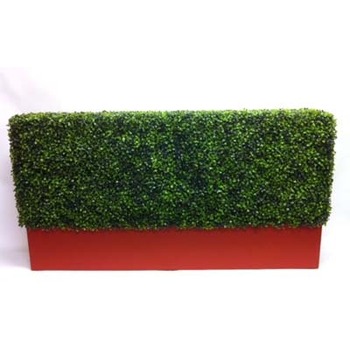
Why not permit portable clothes lines with conditions that they be obscured wherever possible by barriers such as real or faux potted plants, or balcony furniture? There are faux box hedges, such as the one pictured below, that could act as screening material on a glass balcony.
 16/12/2017 at 5:24 pm in reply to: Child-safe window check reveals unauthorised changes in bathroom. #28879
Winston – Your description of the problem was a bit confusing to me. How high is the bathroom window above the floor level? See diagram …. Is a safety device necessary? Sometimes windows in shower recesses are above 1.7m high.

If a safety device is required but cannot be installed due to an illegal owner modification of a common property window then, in my opinion, the OC has a couple of options.
Discuss all of these options with the Owner and work out which suits both Parties:
(1) The OC permanently fixes the window shut.
(2) The Owner restores the window to its original state to enable the OC to install an ordinary safety device.
(3) The Owner pays the additional cost (over and above the cost of what an ordinary safety device for that window would be) for the OC to install a special metal grille or bars on the inside face of the window if and where possible.
(4) Due to the special nature of this problem the owners corporation could adopt a common property rights by-law which confers the right and obligation to install and maintain any locking or safety device to the individual lot owner. Both the Owner and the OC would need to agree to this, and the reasons for the granting of this unusual obligation would need to be clearly stated in the Explanatory Material for the Motion, and the by-law. This will allow for full transparency should any future problems arise. See https://www.fairtrading.nsw.gov.au/ftw/Tenants_and_home_owners/Strata_schemes/Repairs_and_maintenance.page
-
AuthorReplies