
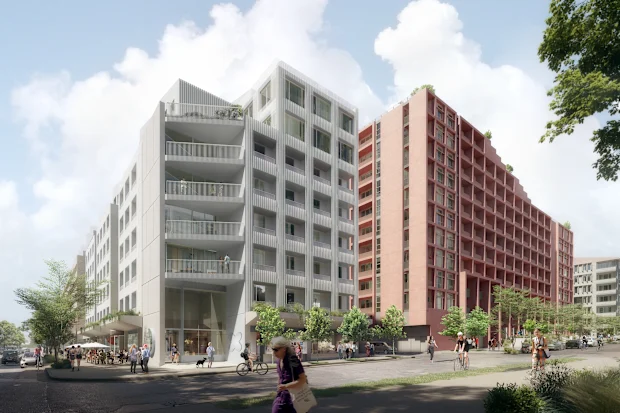
The approval of a $1.5 billion, 1,166-home precinct in Sydney’s inner west is the latest milestone in what has become one of the most dramatic transformations in Australian property in a generation.
But even as The Living Company prepares to break ground at Marrickville Timberyards this month, the sector it represents faces a critical test: whether ambition can survive the economics of actually building.
The Marrickville project, seven buildings on a 2.2-hectare former industrial site, with 100 affordable apartments and possible seniors housing mixed in, encapsulates everything the build-to-rent (BTR) sector has come to stand for.
Institutional money (in this case Dutch pension fund APG, property manager Bouwinvest and Korean fund NPS), long-term ownership, professional management, and a deliberate play on Australia’s rental crisis. Construction will begin this month, with the first 661 homes expected by late 2028 and a further 513 by mid-2029.
Pivotal moment
It arrives at a pivotal moment for the sector. A record 6,000 new BTR units are on track for completion in 2025, up from 4,660 in 2024, and BDO estimates the national pipeline has grown by more than 10,000 apartments and nearly $9 billion over the past 12 months.
Institutional investment in residential real estate is no longer a side bet, it has become a central strategy for long-term value, with 80 per cent of BTR apartments in the pipeline now managed by dedicated platforms.
The Living Company’s co-founders Craig Carracher and Stephen Gaitanos, who built Scape into the country’s largest student accommodation provider with 19,500 beds, are among the most aggressive players in this expansion.
Their Rent to Live fund already has around 1,000 units under construction on two other Sydney sites in Zetland and Waterloo, and the company has set a target of 10,000 build-to-rent homes by 2035, part of a broader portfolio exceeding $17 billion in funds under management.
Yet for all the momentum, the sector is confronting some sobering realities. Despite the surge in 2025, the delivery pipeline is expected to fall back to around 4,000 units in 2026, with approximately 20,500 DA-approved units stalled and awaiting financial backing or policy clarity. The constraint isn’t demand, occupancy rates are high and rental growth is steady, but feasibility. Rising delivery costs, tight labour markets and decades of declining building productivity pose a far greater challenge than demand or capital, with many approved BTR projects unable to proceed at acceptable returns under current delivery conditions.
Marrickville Timberyards, with builders Dasco and Infinity Constructions already appointed, appears to be one of the projects that has cleared that bar. Its sustainability credentials, targeting a 4-star Green Star rating and a 7.5-star NatHERS energy rating, reflect the ESG demands of its institutional backers.
Competitive rates
Its 726 bicycle spaces and resident electric vehicle car-share scheme signal the kind of amenity-driven model that distinguishes institutional BTR from the traditional private rental market. Rents, Carracher says, will be set at competitive market rates, the pitch is aimed at young renters and families priced out of Marrickville who have drifted to suburbs like Burwood.
Australia’s BTR market is still in its infancy, with just 0.29% of rental housing institutionally owned and managed, compared to significantly higher proportions in the UK and US. That gap represents the opportunity that funds like Rent to Live are chasing, and the scale of what still needs to be built to meaningfully move the needle on Australia’s housing shortfall.
The passage of the Build-to-Rent Bill in late 2024 cut the withholding tax for foreign investors from 30 per cent to 15 per cent and raised the capital works tax deduction from 2.5 per cent to 4 per cent, changes designed to make projects like Marrickville Timberyards more attractive to the offshore pension capital that underpins them.
Whether the sector can convert its pipeline potential into delivered stock at scale remains the open question. The approvals are there. The capital is there. The demand is not in doubt. What analysts are watching now is whether developers can build fast enough, cheaply enough, to justify the ambition.
Marrickville Timberyards, breaking ground this month, is one of the clearest tests of that proposition yet.
› Forums › Current Page
Australia’s build-to-rent wave rolls on, but the growing question is whether the apartments can be built at a cost that makes the rents reasonable.
[See the full post at: Build-to-rent is booming but so are costs]
If you want to be alerted when anyone replies to your posts or responds to this topic, please register and login, then you will be able to subscribe to the topic. The opinions offered in these Forum posts and replies are not intended to be taken as legal advice. Readers with serious issues should consult experienced strata lawyers. NB: Longer threads may spill over to additional pages - look for the numbers on the bottom right, under the last post.
› Forums › Current Page
› Forums › Current Page