
Forums Common Property Current Page

  • Creator
    Topic
  • #12021 Reply | Quote
    Cheeseman2017
    Flatchatter

      Got an urgent, complex issue with my investment property.

      My (spa) bath /shower over bath is leaking and has caused damage to the unit below.  It happened once before 5 years ago and an insurance claim was put in by the OC for damage caused to the unit downstairs. Recent investigation pinpointed the problem to a fine crack between bath and wall. A strip of silicone will probably prevent further leaks (as long as it lasts). Simple.

      BUT…. the owner below and their plumber, who I kindly granted access to when we were trying to diagnose the problem, established that there was no waterproofing under my tub. Waterproofing under the tub would probably have staved off/delayed the damage to the unit downstairs. It was also discovered, during this investigation, that the configuration of my bathroom, as well as the existence of a spa bath, differs from the plan when the building was built, so it’s being deemed ‘illegal’ by the Owners Corp.  

      I DID NOT MODIFY THE BATHROOM AND I HAVE PROOF.  It was the way it was since the day I purchased it 20 years ago. The building was just 2 years old when I bought my unit, so the bathroom was most likely modified by the builder without the Private Certifier or Council at the time noticing the anomaly (or caring).  I highly doubt the previous owner did it because it would have caused a racket with plumbing changes etc.  Plus, who in their right mind would rip up a 12 month old bathroom and spend what would be $15K odd today just to facilitate a spa bath?

      The Owners Corp are now demanding I rip up the bath, waterproof under the bath at my expense and prove them its all been done within 30 days, or else….(threats of legal action, claim for past damage compensation of rent to unit below, claiming the excess on the insurance claims and any past claims that are related to leaks below etc etc).  They’re saying it’s my problem irrespective of whether I did the mods, citing that I inherited the issue when I bought the unit.  Buyer Beware is their conclusion.

      If the bathroom was original and didn’t differ from the plans lodged, then I have a case  (I think), because the floor and waterproofing membrane (or lack thereof) is common property….I think.

      Anyway long story short, am I liable and do I need to fix this completely at my expense? Is the fact that the bathroom config and fixtures is different to the council plan, my inherited problem and my ‘Caveat Emptor’?

      Have been losing a lot of sleep over the issue since receiving the letter.  The OC are refusing to accept any responsibility because according to them, and since the bathroom differs from the plan, it must have been modified illegally and therefore, its not common property and my problem.  


      What should I do next?  If I take this to the Tribunal, will they decide in my favour?  Or am I in trouble?


      Thanks
    Viewing 12 replies - 1 through 12 (of 12 total)
    • Author
      Replies
    • #30715 Reply
      Cheeseman2017
      Flatchatter
      Chat-starter

        FYI, the property is in NSW.  Tribunal will be NCAT.

        #30724 Reply
        Lady Penelope
        Flatchatter

          I have a couple of comments: Firstly, you probably need to employ the services of a lawyer. There are some tricky legal questions to answer.

          I own a Lot within a scheme in Queensland which was built 60 years ago. My Lot configuration in the bathroom differs  slightly in configuration from the original plans. This is not unusual. Changes to the building plans often occur during construction. The finished complex or unit may not be the same as in the original plan. This is by no means illegal.

          If a purchaser buys off the plan then the owner often exercises their right to change some elements at the build stage. This may have happened in the bathroom at your Lot – particularly if changes to placement of plumbing fixtures occurred. Its always cheaper to make changes at the build stage. Maybe the original builder offered an upgrade such as a spa bath?

          A changed plan does not necessarily mean that the responsibility for the waterproofing falls on you. If the bathroom was configured differently at the initial build stage then the water proofing should still be the responsibility of your strata scheme.

          Having a bathroom that is different from other bathrooms does nor prove definitively that the bathroom was changed after it was built, nor does it prove that it was illegal.

          Incidentally, glazing, waterproofing, termite barriers and pest treatments are elements that are covered by certification issued by the manufacturer or installer. 

          A Final Occupation Certificate is issued to an owner on completion of building work. It certifies that the work complies with Council conditions of approval and the Building Code of Australia. It permits the house to be occupied. However, the Council Certificate is limited in scope – it does not certify absence of defects.

          I am not a builder or a lawyer but I believe that your strata scheme is wrong to blame you for this problem without them first establishing when your bathroom was constructed (e.g. during the initial construction, or post construction), and when it was certified and whether it has been properly certified.

          If the owner’s corp can PROVE that your bathroom was modified after the building was constructed and had passed its original certification then you may have a bigger problem. The buyer beware doctrine generally applies.

          The only recourse buyers have against a former owner (and selling agent) is an action in damages for misleading or deceptive misrepresentations about the structural soundness relied upon by the buyer.

          Taking this action in court is a very difficult, costly and stressful path to take. Unfortunately, sellers do not necessarily have to disclose defects of which they are aware.

          For now though, if I was you I would get a plumber to fix the shower with the silicone to stop it from leaking, and wait until the owner’s corp provides proof that you are in the wrong. In my opinion, they have not done this yet.

          Keep the plumbing receipt! Adjudicators generally prefer repairs to be undertaken by competent tradespeople. 

          #30725 Reply
          Whoopi
          Flatchatter

            HI 


             I have just gone through something slightly similar. Be careful not to allow this to escalate emotionally with your SC. Get as much information as you can from your council. There may be records of the changes made to the original design in council records. Going to NCAT is not an easy quick or cheap exercise. Neither are lawyers. Your OC will probably have  legal defence insurance while you will be paying our of your pocket. So I agree with getting legal advice but be proactive find out as much as you can yourself. Make sure the lawyer is Strata Specific. Keep the lines of communication open with your committee, a compromise might be easier than months or years of legal action. Keep a diary of events.

            Lady Penelope is right about taking this to court it is very very stressful.


             Good luck

            #30726 Reply
            Cheeseman2017
            Flatchatter
            Chat-starter

              If they don’t prove it was original, and in my defence, I manage to find proof that it is, does the spotlight then get shone on them, the OC (rather than me), and why they didn’t act when this problem first surfaced?

              #30730 Reply

              It may also be worth checking with the local building authority on the building code for Tub installations as a wetsealing membrane is not required under a bath. Especially 22yrs ago. 

              The sealing process is carried out to the sill or top edge of the tub and the tub itself is the water proof surface.  

              #30737 Reply
              Lady Penelope
              Flatchatter

                Good advice ‘Sanctuary’! 

                Cheeseman2017 – Owner’s corps usually try to avoid paying out money for repairs if they can get away with it. Some try and ‘bluff’ you and intimidate you.

                Owner’s corps are not experts in the building trade nor in the legal profession, but many pretend to be so.

                If you believe that you are ‘in the right’ then please don’t be intimidated by your OC.

                The OC cannot force you to pay any money for these types of repairs up front. The OC must bear the cost of these repairs from the OC’s funds and only after the repairs have been made can they seek compensation, which they may need to do via NCAT.  

                Fix what you can fix i.e. having a plumber reseal the bath seal, then wait and see what happens next with the OC.

                In the meantime, follow Sanctuary’s advice and try and find out what the standards and codes were 22 years ago. Perhaps an older plumber, who may have been in the plumbing trade for over 22 years, may be able to advise you.

                #30739 Reply
                Cheeseman2017
                Flatchatter
                Chat-starter

                  Really appreciative of the feedback guys.  I have seen Jimmy’s views on the topic stating that if a previous owner did unauthorised works, then the new owner is basically relieved of responsibility when it comes to common property, or something to that effect.

                  I’ve been told that this is somewhat incorrect.  For a while, thought that view would greatly aid my case but…. 

                  #30740 Reply
                  Jimmy-T
                  Keymaster

                    What you’ve said is not exactly what I have said. 

                    I have said in the past that changes to common property that were done without approval (or restriction) are the responsibility of the owners corporation once the owner who made the changes has moved on.  I’d like to see any evidence that this is not the case.

                    But regardless of that, a subsequent owner still has a responsibility not to damage common property 

                    If you want to be alerted when anyone replies to your posts or responds to this topic, please register and login, then you will be able to subscribe to the topic. The opinions offered in these Forum posts and replies are not intended to be taken as legal advice. Readers with serious issues should consult experienced strata lawyers. NB: Longer threads may spill over to additional pages - look for the numbers on the bottom right, under the last post.
                    #30741 Reply
                    Cheeseman2017
                    Flatchatter
                    Chat-starter

                      Maybe I’ve read that JS Mueller article one too many times :(.   Have you seen many instances where NCAT decided similar matters as you’ve portrayed it above?

                      #30748 Reply
                      Lady Penelope
                      Flatchatter

                        Problems with defects in the waterproofing at the construction stage are very common.

                        https://www.choice.com.au/money/property/buying/articles/apartment-building-defects

                        The statutory warranty period for the 22 year old building has expired long ago.

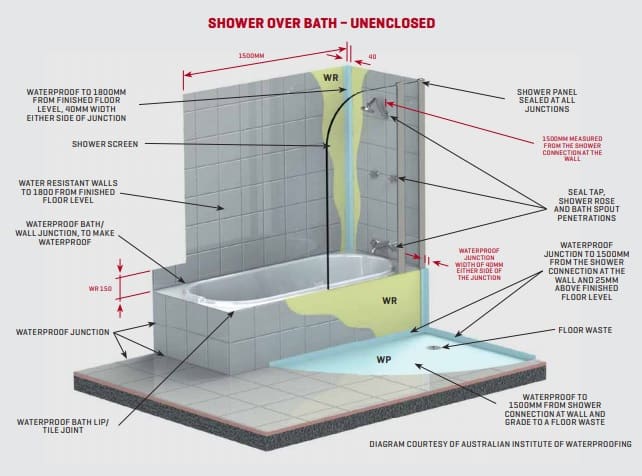
                        From my reading of the issue of waterproofing it was only from 2004, that the Australian Standards required waterproofing membranes to be applied to shower stalls and across bathrooms. Check with a plumber though.

                        Also, the new codes require that baths with an integral vertical upstand lip along the side of the bath walls are required to be recessed to enable the junction to be waterproofed. Baths without an integral edge require
                        full waterproofing of the walls and floor area around and under the bath.

                        I am not sure whether there are stricter rules for apartment buildings than there are for normal residential houses.

                        WR means water resistant. WP means waterproof.

                        1

                        #30753 Reply
                        Whoopi
                        Flatchatter

                          @Cheeseman2017 said:
                          Maybe I’ve read that JS Mueller article one too many times :(.   Have you seen many instances where NCAT decided similar matters as you’ve portrayed it above?  

                           What JS Mueller article is that?  I am interested.

                          #30755 Reply
                          Cheeseman2017
                          Flatchatter
                          Chat-starter
                          Viewing 12 replies - 1 through 12 (of 12 total)
                          Reply To: Am I liable for leaks under bath?
                          PLEASE ... If your property is not in NSW, mention its location (state). Don't identify companies or individuals by name. Don't mention or promote your company or services. Keep acronyms and initials to a minimum. Please, don’t use “quote” unless there is a specific point to which you wish to refer, then highlight (define) that specific passage before you click on "quote". Otherwise just use reply. THANKS.

                          You can use BBCodes to format your content.
                          Your account can't use all available BBCodes, they will be stripped before saving.

                          Your information:


                          Forums Common Property Current Page