
- This topic has 4 replies, 3 voices, and was last updated 8 years, 7 months ago by .
-
Topic
-
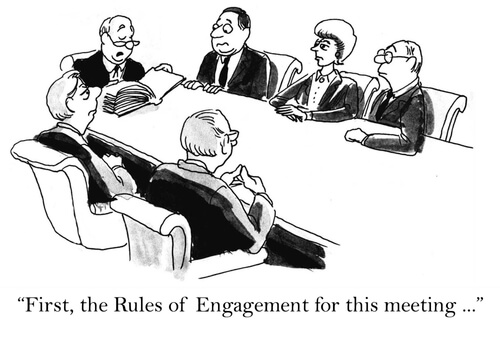
This week’s column in the Australian Financial Review has raised the issue of codes of conduct for committee members and standing orders for committee meetings.
These are two very different things. The Code of Conduct may be part of your strata legislation in some states (notably not NSW) or it could have been adopted as a by-law. Its purpose is to tell committee members how they should behave in the exercise of their roles.
Standing Orders are basically a set of rules that can be adopted as a by-law that help with the smooth running of committee meetings.
We reproduce the Codes of Conduct from several states below and there is considerable discussion about what works and what doesn’t HERE in the Forum. But first, here is a suggested format for standing orders that might help you to bring your committee meetings under control.
STANDING ORDERS
You can devise your own standing orders from scratch or based on existing SOs from other sources. The meetings handbook Roberts Rules is a favourite starting point but remember, no standing orders are enforceable unless they have been adopted as a by-law – and that means in most states that they can’t be unreasonable or oppressive.
The following Standing Orders have been devised for Flat Chat based on NSW strata laws. Some of those laws have been included in the SOs so as to bring all the rules together in one document.
However, you might want to make your standing orders more succinct by assuming knowledge of those laws. Either way, the intention of the standing orders is to give the chair the mechanism to control overly dominant and/or unruly behaviour by committee members and resident attendees.
Suggested Standing Orders for Strata Committees (based on NSW strata law)
NB: These are only a suggestion – they can and should be adapted for your circumstances and then must be registered as a by-law to have any effect.
- The meeting may not commence until the quorum of attendance (50 percent of the membership as decided at the previous AGM) has been reached. Acting members’ (proxy) votes may not be counted towards the quorum.*
- The meeting must be chaired by the elected chairperson unless they are absent or unable to do so, in which case the committee must elect a chair for the duration of that meeting.*
- Voting on committee matters is by a show of hands with each member carrying only one vote (unless they have been granted an acting member vote in writing by a member who cannot attend and the committee has agreed to it being allowed).*
- A simple majority of the committee in attendance can choose not to allow acting member votes if they so wish.*
- Members can be considered to be in attendance if they are present by telephone, video streaming or other electronic means.*
- The committee must allow non-committee members to attend the meeting but they are only permitted to speak if a majority of the committee agrees.*
- The committee may decide by a simple majority whether or not non-committee members should speak only on specific items on the agenda or on any or all agenda items.*
- In a tied vote, the Chairperson does not have a casting vote and any motion will be considered not to have been carried if it remains tied after a re-vote.*
- The chair should make it clear to non-committee members that they are bound by the Standing Orders.
- The committee will consider the items on the agenda in the order in which they appear unless a majority of the committee agrees to change the order at the meeting.
- The Chairperson will allow each participating member or attendee to speak only once on a topic until everyone who wants to speak has had a chance to do so. The same restriction will apply after each time an attendee speaks.
- After discussions, and before a vote, the Chair will call for anyone who wishes to raise a point that has not already been discussed, to do so.
- Once a vote has been taken and the meeting has moved on to the next agenda item, a previous motion may not be revisited.
- Attendees and members who interrupt, talk out of turn or talk over other members may be warned verbally that their behaviour is not acceptable.
- If the behaviour is repeated despite a warning, the chairman can call for a vote of the committee to ‘name’ the miscreant in the minutes of the meeting.
- The meeting will be called to a close after the final item has been discussed and voted upon.
- If there is persistent disruption, the chair can propose the meeting be adjourned at any point, subject to the approval of the committee, with the remaining items to be decided “on paper”.
- There is no “any other business”.* Any items not on the agenda can only be discussed informally after the end of the meeting and no vote should be taken or recorded.
*Items 1 to 8 plus 18 are already part of NSW strata laws or regulations.
CODES OF CONDUCT
NSW has the least detailed Code – so loose it’s almost irrelevant. Queensland has the most detailed, including penalties that can be imposed for breaches. One thing worth noting is that you can’t make signing up to your Code of Conduct a condition of membership of your committee – tht would breach every owner’s right to be elected.
Here are some of the Codes from various states.
NSW: Duties of Committee members
It is the duty of each member of a strata committee of an owners corporation to carry out his or her functions for the benefit, so far as practicable, of the owners corporation and with due care and diligence.
Victoria: Duties of committees and sub-committees
A member of a committee or sub-committee of an owners corporation—
(a) must act honestly and in good faith in the performance of his or her functions; and
(b) must exercise due care and diligence in the performance of his or her functions; and
(c) must not make improper use of his or her position as a member to gain, directly or indirectly, an advantage for himself or herself or for any other person.Queensland: Code of conduct for committee voting members
- Commitment to acquiring understanding of Act, including this code
A committee voting member must have a commitment to acquiring an understanding of this Act, including this code of conduct, relevant to the member’s role on the committee.
- Honesty, fairness and confidentiality
(1) A committee voting member must act honestly and fairly in performing the member’s duties as a committee voting member.
(2) A committee voting member must not unfairly or unreasonably disclose information held by the body corporate, including information about an owner of a lot, unless authorised or required by law to do so.
- Acting in body corporate’s best interests
A committee voting member must act in the best interests of the body corporate in performing the member’s duties as a committee voting member, unless it is unlawful to do so.
- Complying with Act and this code
A committee voting member must take reasonable steps to ensure the member complies with this Act, including this code, in performing the member’s duties as a committee voting member.
- Nuisance
A committee voting member must not—
(a) cause a nuisance on scheme land; or
(b) otherwise behave in a way that unreasonably affects a person’s lawful use or enjoyment of a lot or common property.
- Conflict of interest
A committee voting member must disclose to the committee any conflict of interest the member may have in a matter before the committee.
Queensland: Notice for breach of code of conduct
(1) If a body corporate believes a voting member of the body corporate’s committee has breached the code of conduct for the member, the body corporate may decide, by ordinary resolution, to give the member a written notice stating each of the following—
(a) that the body corporate believes the member has breached a stated provision of the code of conduct;
(b) details sufficient to identify the breach in not more than 600 words;
(c) that the member may give any other member of the body corporate, within the stated period of at least 21 days after the member is given the notice, a written response to the notice in not more than 600 words;
(d) that, if asked by the member, the body corporate will pay the member all postage charges and photocopy expenses reasonably incurred by the member in giving a written response under paragraph (c) to any other member of the body corporate;
(e) that the body corporate is to consider a motion to remove the member from office for the breach at the next general meeting of the body corporate called after the period mentioned in paragraph (c) ends.
(2) If asked by the member, the body corporate must pay the member all postage charges and photocopy expenses reasonably incurred by the member in giving a written response under subsection (1)(c) to any other member of the body corporate.
ACT: Executive committees—code of conduct
1 Understanding of Act and code
An executive member must have—
(a)a commitment to acquiring an understanding of the Act, as relevant to the member’s role on the executive committee; and
(b)a good understanding of this code.
2 Honesty and fairness
An executive member must act honestly and fairly in exercising the member’s functions as an executive member.
3 Care and diligence
An executive member must exercise reasonable care and diligence in exercising the member’s functions as an executive member.
4 Acting in owners corporation’s best interests
An executive member must act in the best interests of the owners corporation in exercising the member’s functions as an executive member, unless it is unlawful to do so.
5 Complying with Act and code
An executive member must take reasonable steps to ensure that the member complies with the Act, including this code, when exercising the member’s functions as an executive member.
6 Nuisance
An executive member must not—
(a) cause a nuisance on the land; and
(b) otherwise behave in a way that unreasonably affects a person’s lawful use or enjoyment of a unit or the common property.
7 Unconscionable conduct
An executive member must not engage in unconscionable conduct in exercising the member’s functions as an executive member.
Examples
1 improperly using the executive member’s position on the executive committee to gain, directly or indirectly, an advantage personally or for someone else
2 exerting undue influence on, or using unfair tactics against, the owner of a unit in the units plan
Note An example is part of the Act, is not exhaustive and may extend, but does not limit, the meaning of the provision in which it appears (see Legislation Act, s 126 and s 132).
8 Conflict of interest
An executive member must disclose to the executive committee any conflict of interest the member may have in a matter before the committee.
Suggested Standing Orders for Strata Committees ( based on NSW strata law)
- The meeting may not commence until the quorum of attendance (50 percent of the membership as decided at the previous AGM) has been reached. Acting members’ (proxy) votes may not be counted towards the quorum.*
- The meeting must be chaired by the elected chairperson unless they are absent or unable to do so, in which case the committee must elect a chair for the duration of that meeting.*
- Voting on committee matters is by a show of hands with each member carrying only one vote (unless they have been granted an acting member vote in writing by a member who cannot attend and the committee has agreed to it being allowed).*
- A simple majority of the committee in attendance can choose not to allow acting member votes if they so wish.*
- Members can be considered to be in attendance if they are present by telephone, video streaming or other electronic means.*
- The committee must allow non-committee members to attend the meeting but they are only permitted to speak if a majority of the committee agrees.*
- The committee may decide by a simple majority whether or not non-committee members should speak only on specific items on the agenda or on any or all agenda items.*
- In a tied vote, the Chairperson does not have a casting vote and any motion will be considered not to have been carried if it remains tied after a re-vote.*
- The chair should make it clear to non-committee members that they are bound by the Standing Orders.
- The committee will consider the items on the agenda in the order in which they appear unless a majority of the committee agrees to change the order at the meeting.
- The Chairperson will allow each participating member or attendee to speak only once on a topic until everyone who wants to speak has had a chance to do so. The same restriction will apply after each time an attendee speaks.
- After discussions, and before a vote, the Chair will call for anyone who wishes to raise a point that has not already been discussed, to do so.
- Once a vote has been taken and the meeting has moved on to the next agenda item, a previous motion may not be revisited.
- Attendees and members who interrupt, talk out of turn or talk over other members may be warned verbally that their behaviour is not acceptable.
- If the behaviour is repeated despite a warning, the chairman can call for a vote of the committee to ‘name’ the miscreant in the minutes of the meeting.
- The meeting will be called to a close after the final item has been discussed and voted upon.
- If there is persistent disruption, the chair can propose the meeting be adjourned at any point, subject to the approval of the committee, with the remaining items to be decided “on paper”.
- There is no “any other business”.* Any items not on the agenda can only be discussed informally after the end of the meeting and no vote should be taken or recorded.
*Items 1 to 8 plus 18 are already part of NSW strata laws or regulations.
If you want to be alerted when anyone replies to your posts or responds to this topic, please register and login, then you will be able to subscribe to the topic. The opinions offered in these Forum posts and replies are not intended to be taken as legal advice. Readers with serious issues should consult experienced strata lawyers. NB: Longer threads may spill over to additional pages - look for the numbers on the bottom right, under the last post.