
Forum Replies Created
-
AuthorReplies
-
The following document may be useful:
http://www.tenantsrights.org.au/Resources/Renovations/Renovation%20intro%20sheet.pdf
If the security grilles were installed by the developer as part of the original building then they would most probably be the responsibility of the OC to repair and replace.
If they were installed by the owners after the apartments were sold then they would be owner responsibility.
The fact that not all the grilles are the same and that not all apartments have grilles may indicate that they were installed after the apartments were initially sold.
The most reasonable solution would be for the OC to write the by-law stating that owners can install a motor on their garage door at their own expense and that all maintenance of the motor and its associated parts are to be at the owners expense.
Happy Strata – Not every committee made ‘house rule’ is a reasonable ‘rule’. I have first hand experience of this.
‘House rules’ can and frequently do severely impact on other people’s lives. In that circumstance I would take the route of ignoring the committee made ‘rule’.
In addition, committee ‘rules’ are not easily identified when undertaking due diligence. Hence the need for enforceable and correctly documented by-laws which are easily sourced.
A committee that willfully ignores the legislation is not a good committee.
22/11/2018 at 1:05 am in reply to: Capital offences – gentrification opens the door to … guess who #30792Jimmy T – As a frequent visitor to the DC area (and Arlington in particular) the locks that you see outside of apartment blocks are generally not for AirBNB tenants but are for real estate agents who are showing their clients through properties that are for sale or for normal rental within those buildings.
Often properties are listed with many agents. Rather than each agent having a set of keys the keys are locked within a ‘lock box’ and only the code to open the ‘lock box’ needs to be sent to the various agents.
I agree that some may be for AirBNB but generally the majority are for legitimate sellers or rental agents.
I don’t know what the situation is in NSW but in QLD the ‘Act’ (the BCCMA) does not provide for a separate rule-making process other than the making of by-laws. The Act and the Standard Module provide the means by which rules governing community titles schemes are to be made, and that is the by-law system.
Committee’s ‘house rules’ are unenforceable. Therefore any committee rules about CCTV are also unenforceable.
The system is based on lot owners having input into the rules under which they are governed, by way of voting and resolution rights. The system requires transparency, so that all owners and potential purchasers are aware of, and can contribute to, the by-laws under which a scheme is governed. Any rule not made in compliance with the by-law regime established by the Act and the applicable regulation module is enforceable and beyond the scope of the Act.
House rules are not enforceable unless they are registered as by-laws in the CMS. By-laws do not take effect (in other words, are not enforceable) until the CMS is registered with the Titles Office.
Help_1: Thanks for the extra info.
Is there a By-law in place at your scheme which prevents, or governs a/c installation?
Town houses sometimes differ from multi level Lots with regard to common property. Townhouses may have different boundaries for common property (particularly if they are detached town houses) and different definitions of what is structural and who owns and is responsible for maintenance of the exterior walls etc. You may need to check up on this.
Section 110[1] may not even need to apply to you. The a/c will be installed within your own Lot boundary and the exterior wall may not be common property that is “in connection” with your Lot. This is clearly something that you will need to clarify.
110 Minor renovations by owners(1) The owner of a lot in a strata scheme may carry out work for the purposes of minor renovations to common property in connection with the owner’s lot with the approval of the owners corporation given by resolution at a general meeting. A special resolution authorising the work is not required.
The requirement for an a/c to be approved by the OC as an Ordinary Resolution only applies if the a/c will impact on common property.
Perhaps that is why Lot 3 has installed an a/c without any paperwork or written approval.
If the OC has not requested the removal of the a/c at Apartment 3 then it appears that tacit approval has been given, or acquiescence has occurred.
However, if you do decide that the a/c installation is “in connection to common property” then you will need to submit a proposal to the OC regarding the a/c installation. This written notice should include all details you have about the system you’d like to install, including brands, installer information, photographs of where the system would be installed and any relevant plans.
As Jimmy has said, you will need approval via an Ordinary Resolution. Approval cannot be unreasonably withheld.
If you want to speed up the process then you could offer to pay the cost of holding an EGM. Depending upon the size of the strata scheme this suggestion may not be too expensive. Find out the cost before making the offer though.
Help_1: A few of questions for you ……. Are you in a town house? Has anyone else in the building received approval to install an a/c unit? How did they do it?
Is the wall between your kitchen and garage deemed to be an internal wall? Is the roof space deemed to be common property? Will you be cutting through a slab between the two floors? On the Strata Plan is the balcony on your Title? Is the exterior condenser unit likely to cause a noise nuisance to adjoining properties? How is the condensate from the condenser unit being dealt with?
Pyrmont Building Manager – Is it legal or illegal in NSW to sub-let an apartment if you are a Tenant?
I leased out my apartment in QLD for a period of 3 years several years ago …. and from memory sub-letting was not allowed in the Tenancy Agreement. I am not sure if that is the same situation in NSW???
If tenants do the wrong thing and sub-let without owner permission then can they be put on a tenant ‘black list’?
A lot of STRs would disappear if the tax department became more involved in rooting out the tax ‘cheats’.
17/11/2018 at 11:33 am in reply to: Strata Committee voting and deciding without telling owners #30766You are in a 30 Lot scheme. That would be categorized as a medium sized scheme. It is not unreasonable to expect that at least some committee meetings are held per year. Your scheme deserves to have a committee that functions in a transparent manner.
A 91 page AGM Agenda appears to indicate that your committee is not functioning correctly.
Your scheme appears to be undertaking some major projects at the moment. There are certain decisions that a Committee cannot make. There are decisions that can only be made by the owners corporation at a General Meeting. Has your committee overstepped their authority?
Any owner can raise a Motion for inclusion at an AGM. If there is sufficient support for the Motion and the Motion is ‘reasonable’ then the Motion will Pass. The committee must then abide by the directive outlined in the Motion.
The owners corporation can direct the committee to function in any way that the owner’s corporation chooses, so long as the directive is legal and reasonable. As an example, the owner’s corporation could direct the committee to hold a ‘reasonable’ number of meetings per year, and to hold the meetings in manner (except in emergencies) that permits owners to attend the meetings. The owner’s corporation can direct the committee to limit its spending to a certain amount, or to obtain a certain number of quotes for items of above a certain expenditure, or to submit a 300 – 500 word Explanation with any Motion that is proposed by the committee.
Although the committee has certain ‘powers’, it is the owner’s corporation that has the ultimate ‘power’ in the strata scheme.
https://www.lookupstrata.com.au/nsw-strata-executive-committee-not-acting-appropriately/
You may need to take the matter further through the Office of Fair Trading and/or NCAT (see Options 6 and 7). You have already taken the first step by seeking help from a strata lawyer. Perhaps the legal advice that you have already obtained can form the basis of your application.
16/11/2018 at 11:24 am in reply to: Strata Committee voting and deciding without telling owners #30760BondiLocal – The following document may help you.
The Committee can make resolutions ‘in writing’ outside of holding a formal committee meeting however they must abide by the correct legal protocols under the Strata Schemes Management Act for this type of meeting which include:
- providing the owners with the correct Notice of the ‘in writing’ Meetings (i.e. at least 3 days),
- providing the owners with an Agenda including Motions that will decided at the Meeting,
- and providing the owners with the Minutes of Meeting within 7 days of holding the ‘in writing’ Meeting, including all of the decisions made.
‘In writing’ meetings, although permitted, are generally not preferred as a substitute to replace all Committee Meetings. ‘In writing’ Meetings are generally used in ’emergencies’. This is because transparency of decision making is of paramount concern in the Legislation.
You can also raise a Motion at the next General Meeting that requires there to be a minimum of 3 ‘formal’ Committee Meetings per year. You could define a ‘formal’ Committee Meeting as that which is not an ‘in writing’ Meetings. This allows owners to attend the ‘formal’ Committee Meetings – which they obviously cannot do if the Meeting is held ‘in writing’.
If the Owners Corporation votes to support your Motion then the Committee will not be permitted to hold all of their meetings ‘in writing’ and you should therefore achieve a better transparency at your scheme.
However, you will probably have missed out on your opportunity to submit this Motion for the upcoming General Meeting. It appears that your General Meeting Agenda has already been sent to the owners and your General Meeting is next week.
Daisy55 – Fortunately the Victorian proxy rules (e.g. the amount of proxies one person can hold at an owners corporation meeting is currently unlimited) are under review. I hope for your sake that they change soon to bring them into line more with NSW and QLD.
Problems with defects in the waterproofing at the construction stage are very common.
https://www.choice.com.au/money/property/buying/articles/apartment-building-defects
The statutory warranty period for the 22 year old building has expired long ago.
From my reading of the issue of waterproofing it was only from 2004, that the Australian Standards required waterproofing membranes to be applied to shower stalls and across bathrooms. Check with a plumber though.
Also, the new codes require that baths with an integral vertical upstand lip along the side of the bath walls are required to be recessed to enable the junction to be waterproofed. Baths without an integral edge require
full waterproofing of the walls and floor area around and under the bath.I am not sure whether there are stricter rules for apartment buildings than there are for normal residential houses.
WR means water resistant. WP means waterproof.
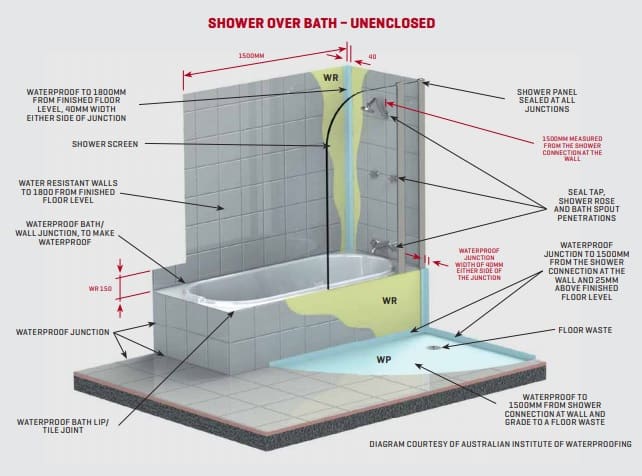
Good advice ‘Sanctuary’!
Cheeseman2017 – Owner’s corps usually try to avoid paying out money for repairs if they can get away with it. Some try and ‘bluff’ you and intimidate you.
Owner’s corps are not experts in the building trade nor in the legal profession, but many pretend to be so.
If you believe that you are ‘in the right’ then please don’t be intimidated by your OC.
The OC cannot force you to pay any money for these types of repairs up front. The OC must bear the cost of these repairs from the OC’s funds and only after the repairs have been made can they seek compensation, which they may need to do via NCAT.
Fix what you can fix i.e. having a plumber reseal the bath seal, then wait and see what happens next with the OC.
In the meantime, follow Sanctuary’s advice and try and find out what the standards and codes were 22 years ago. Perhaps an older plumber, who may have been in the plumbing trade for over 22 years, may be able to advise you.
I have a couple of comments: Firstly, you probably need to employ the services of a lawyer. There are some tricky legal questions to answer.
I own a Lot within a scheme in Queensland which was built 60 years ago. My Lot configuration in the bathroom differs slightly in configuration from the original plans. This is not unusual. Changes to the building plans often occur during construction. The finished complex or unit may not be the same as in the original plan. This is by no means illegal.
If a purchaser buys off the plan then the owner often exercises their right to change some elements at the build stage. This may have happened in the bathroom at your Lot – particularly if changes to placement of plumbing fixtures occurred. Its always cheaper to make changes at the build stage. Maybe the original builder offered an upgrade such as a spa bath?
A changed plan does not necessarily mean that the responsibility for the waterproofing falls on you. If the bathroom was configured differently at the initial build stage then the water proofing should still be the responsibility of your strata scheme.
Having a bathroom that is different from other bathrooms does nor prove definitively that the bathroom was changed after it was built, nor does it prove that it was illegal.
Incidentally, glazing, waterproofing, termite barriers and pest treatments are elements that are covered by certification issued by the manufacturer or installer.
A Final Occupation Certificate is issued to an owner on completion of building work. It certifies that the work complies with Council conditions of approval and the Building Code of Australia. It permits the house to be occupied. However, the Council Certificate is limited in scope – it does not certify absence of defects.
I am not a builder or a lawyer but I believe that your strata scheme is wrong to blame you for this problem without them first establishing when your bathroom was constructed (e.g. during the initial construction, or post construction), and when it was certified and whether it has been properly certified.
If the owner’s corp can PROVE that your bathroom was modified after the building was constructed and had passed its original certification then you may have a bigger problem. The buyer beware doctrine generally applies.
The only recourse buyers have against a former owner (and selling agent) is an action in damages for misleading or deceptive misrepresentations about the structural soundness relied upon by the buyer.
Taking this action in court is a very difficult, costly and stressful path to take. Unfortunately, sellers do not necessarily have to disclose defects of which they are aware.
For now though, if I was you I would get a plumber to fix the shower with the silicone to stop it from leaking, and wait until the owner’s corp provides proof that you are in the wrong. In my opinion, they have not done this yet.
Keep the plumbing receipt! Adjudicators generally prefer repairs to be undertaken by competent tradespeople.
-
AuthorReplies