
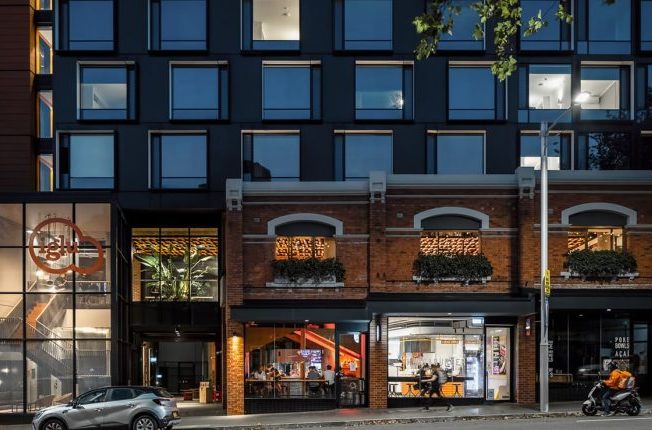
University students may be welcome in the Eastern Sydney City of Randwick but more purpose built commercial apartment blocks to accommodate them certainly aren’t.
In the first Randwick City Council meeting of 2026, councillors unanimously voted to stall future commercial student housing developments, citing a “lack of diversity of housing for families, workers and non-students.”
According to a story on ABC online, The Council has appealed to the NSW Planning Minister to terminate state government incentives that allow high-density student rooms to be built in ways that would otherwise violate space design and parking requirements.
The trigger is stark: more than 5,200 student accommodation rooms have been approved along Anzac Parade between Kensington and Kingsford over the past six years, compared to just 500 residential homes in the same period.
Randwick Mayor Philipa Veitch has pushed back on suggestions the council has failed to plan adequately, noting that 13 major developments have been approved along the Anzac Parade corridor in the past four years, including five high-rise towers over 15 storeys, with those approvals alone set to deliver more than 3,000 new student rooms over the next five years.
But critics of the council’s position are unsparing. Housing economists and pro-density advocates argue that restricting purpose-built supply only pushes students deeper into an already overheated private rental market – with rooms near UNSW already fetching around $700 per week.
A National Boom the Council Cannot Stop
Randwick’s resistance is swimming against a powerful national tide. Australia’s purpose-built student accommodation (PBSA) sector experienced a surge in investment activity during 2025, with transaction volumes exceeding $1.88 billion as offshore investor groups sought exposure to what has become an increasingly attractive institutional-grade asset class.
The development pipeline has expanded significantly, with the latest Urbis Student Accommodation Benchmarks showing 40,000 beds now in various stages of development across the country – up from 36,000 in early 2025. Of these, more than 11,000 beds are under construction, with another 27,000 approved or in planning.
When combined with on-campus and college accommodation, there are now 134,000 student-only beds Australia-wide. The federal government has added further momentum: universities are now permitted to grow international student enrolments in 2026 only if they can demonstrate delivery of additional housing for students, tied to a 25,000-place increase to the National Planning Level for international students.
The investment numbers reflect this confidence. The standout 2025 deal was Greystar’s $1.6 billion acquisition of a joint portfolio from GIC and Wee Hur, comprising 5,662 beds across seven assets. The momentum has continued into 2026, with Centurion Accommodation REIT’s $345 million acquisition of the EPIISOD Macquarie Park facility at a record $471,000 per bed.
Proponents argue the sector benefits the broader housing market, not just students. A 2024 report by the Student Accommodation Council found that international students account for just 6% of the total rental market – reinforcing the value of purpose-built student accommodation in easing pressure without displacing local renters.
The sector’s appeal extends well beyond international students, with many providers reporting more than 50% domestic student occupancy as the broader housing affordability crisis pushes local students toward purpose-built options.
Cities That Welcome It, Cities That Don’t
Not all local governments share Randwick’s scepticism. Property Council figures show that cities like Perth and Adelaide, with investment-friendly settings, have seen a substantial increase in their pipelines. In one quarter – alone, 2,600 approvals were recorded in inner Adelaide.
But barriers remain in other jurisdictions. In Melbourne, each student accommodation bed attracts $2,795 in council rates and state land taxes per year – a burden 126% higher than in other jurisdictions – contributing to a 53% drop in institutional investment in Victorian property since the foreign owner surcharge was doubled in 2023.
The Student Accommodation Council has called on all levels of government to align. The Council has urged states and councils to translate federal policy intent into bricks and mortar, warning that many projects are hampered by inconsistent planning rules and foreign-owner surcharges.
The History That Makes This Debate Urgent
The controversy over who controls student accommodation cannot be separated from the documented history of what happens when students are left to navigate the private rental market alone.
A landmark 2019 survey of more than 5,000 international students, conducted by researchers at UNSW and UTS, painted a disturbing picture of the unregulated share house sector. International students in share houses most frequently encountered illegal or poor living conditions – 57% experienced these conditions in their first share house alone.
Respondents described overcrowding, unsafe accommodation, paying in advance for accommodation that did not exist, intimidation or harassment by landlords or fellow tenants, sudden rent increases, and landlords moving extra people in without consent. Students also reported not getting their bond back, unfair evictions, and sexual harassment.
The exploitation was concentrated where students were most vulnerable: searching remotely before arriving in Australia. Researchers found that 11% of students who used Gumtree paid for accommodation that did not even exist.
But the lead researcher, UNSW’s Bassina Farbenblum, found that arriving in person offered little protection: “Exploitation is thriving unchecked in the wild west of the share house market, and international students can’t avoid it simply by organising housing after they arrive in Australia.”
Most international students found their first share house through unregulated online platforms including Gumtree and Flatmates.com.au, and these students reported the highest rates of deception, overcharging, excessive demands for money upfront and poor living conditions.
The researchers concluded that this exploitation was not confined to any particular student type or institution: poor conditions were similarly reported by students at universities, vocational colleges and English-language colleges, as well as by men and women alike.
The Central Tension
The Randwick debate, seen in this context, is not simply a NIMBY dispute about tower heights. It sits at the intersection of two legitimate concerns: the rights of existing communities to shape their suburbs, and the welfare of a large and historically vulnerable population of students who, when left without regulated alternatives, have too often been exploited.
In Sydney, CBRE estimates that only 6% of students can find accommodation on or near university campuses, while inner and western Sydney alone face an unmet demand of around 25,000 beds.
The purpose-built sector, for all the controversy around its scale and corporate ownership, offers the regulated, managed environment that the old share-house market demonstrably failed to provide. Whether Randwick’s push for tighter controls ultimately protects local residents or simply pushes students back into that unregulated market is, for now, an open question – and one with serious consequences either way.
› Forums › Current Page
Randwick City Council in Eastern Sydney has said ‘no more” to government approval for ten times as many student flats as family homes.
[See the full post at: Council calls for curbs on spread of student flats]
If you want to be alerted when anyone replies to your posts or responds to this topic, please register and login, then you will be able to subscribe to the topic. The opinions offered in these Forum posts and replies are not intended to be taken as legal advice. Readers with serious issues should consult experienced strata lawyers. NB: Longer threads may spill over to additional pages - look for the numbers on the bottom right, under the last post.
› Forums › Current Page
› Forums › Current Page