
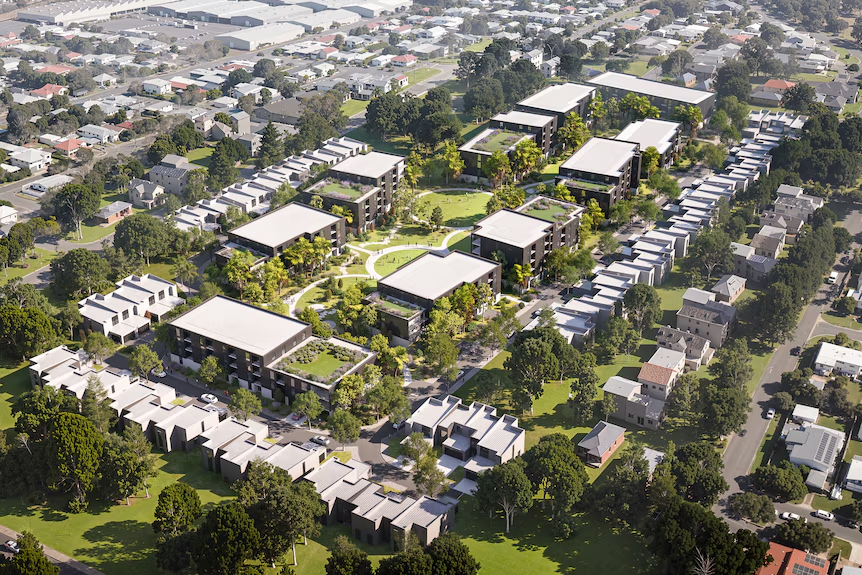
While most of the larger Australian states are pushing ahead with mandated inclusion of affordable homes as a condition of planning approvals and public land sales, one government insists the market alone should dictate the nature of its housing stock.
Despite renters and buyers facing sky-high prices and tight supply, the Queensland government’s new Land Activation Program will release under-utilised public sites to private developers with no requirements for social or affordable housing inclusions.
As reported by ABC News this week, the LNP’s Deputy Premier Jarrod Bleijie launched the initiative at a vacant six-hectare block in Brisbane’s north (Banyo), which could yield up to 400 new homes.
Bleijie emphasised supply as the core fix for the crisis, arguing past mandates under Labor delivered little beyond fenced-off “kangaroo land” and delays.
The program lets the private sector identify and partner on state land, with “use it or lose it” rules forcing government departments to release underused sites.
Developers would then be required to get homes to market quickly but, unlike in other states where access to government land and relaxed planning controls comes with conditions, nothing in the Queenland policy mandates a portion for social housing or affordable homes to buy or rent for people on moderate-to-low incomes.
In fact, Bleijie dismissed the concept of mandates outright: “The former government mandated affordable and social housing, and this is the result: kangaroo land, plovers swooping people, that’s what mandates give. You need to partner with the market to deliver the supply, and the more you mandate, the less (sic) houses you get built.”
Free market
Queensland’s free market stance contrasts with most other states, where conditions are imposed on public or rezoned land to boost affordable homes within a mixture of market-value apartments and townhouses.
New South Wales uses mandatory inclusionary zoning (MIZ) in targeted precincts, especially transit-oriented developments.
Reforms require up to 15% affordable housing in perpetuity in certain rezoned areas near transport hubs, with bonuses for developers providing affordable units such as height and floor space ratio incentives for including 10 per cent of affordable rentals. The Housing SEPP embeds affordability in planning.
Victoria leans heavily on mandates and incentives. Recent reforms enshrine affordable housing obligations in key zones, with tools like inclusionary zoning and developer contributions, such as a proposed 1.75% levy on new developments in activity centres.
Victoria’s Big Housing Build targets thousands of social/affordable homes, and high-rise redevelopments require at least 10 percent more social housing.
South Australia’s Housing Roadmap includes an Affordable Housing Overlay mandating a minimum 15% affordable housing in more residential areas, plus major public housing commitments. That aims for 4,817 homes by 2026, including 1,025 new completions.
Recent federal-state deals, such as providing $800m for 17,000 homes, reinforce targets, with 15% affordable in key projects like Playford Alive East.
‘Reckless’
Queensland critics aren’t convinced by the state government’s market-driven policy. Shadow Housing Minister Meaghan Scanlon called it “reckless” for prioritising developers over those in need, questioning why public land isn’t leveraged for public good.
Queensland Council of Social Services (QCOSS) chief executive Aimee McVeigh described the lack of mandates as “very troubling” and “extremely distressing,” given record-high social housing waitlists.
While welcoming land activation, she stressed governments must do more to boost supply for the most vulnerable.
Property Council of Australia Queensland director Jess Caire backed the approach, noting the private sector delivers 96% of homes and claimed partnerships speed things up in a supply crunch.
Queensland’s broader pledge includes 1 million new homes by 2044, with 53,000 social and affordable—but this program sidesteps direct mandates on public land releases.
Affordability targets
Australia is on track to fall short of the National Housing Accord’s 1.2 million new homes goal by as much as 280,000–426,000 homes by 2029, even as approvals rose to nearly 196,000 in 2025
While actual delivery against state and federal targets remains challenging across the board, states like Victoria and Western Australia are still projected to achieve close to or above their share of the target while still having stronger affordability mandates in place.
This suggests that well-designed requirements for social and affordable housing don’t necessarily slow down overall supply and can coexist with meaningful progress.
For strata residents in Queensland, this highlights the tension: faster supply could ease rental pressure long-term, but without built-in affordability safeguards, the benefits may skew toward higher-end buyers and investors.
Right now, Queensland is wrestling with a system that allows holiday rentals in apartment blocks that were designated as residential-only at the planning stage, not to mention the legalised corruption of pre-sales of management rights that removes the ability of owners to choose their own managers, so as to put more money into developers’ coffers.
Low-income renters and home owners would appear to be critically low on the current government’s list of priorities.
› Forums › Current Page
As states across Australia leverage the release of public land to guarantee the construction of affordable homes, one government is going it alone.
[See the full post at: State says market forces will beat housing crisis]
If you want to be alerted when anyone replies to your posts or responds to this topic, please register and login, then you will be able to subscribe to the topic. The opinions offered in these Forum posts and replies are not intended to be taken as legal advice. Readers with serious issues should consult experienced strata lawyers. NB: Longer threads may spill over to additional pages - look for the numbers on the bottom right, under the last post.
› Forums › Current Page
› Forums › Current Page