
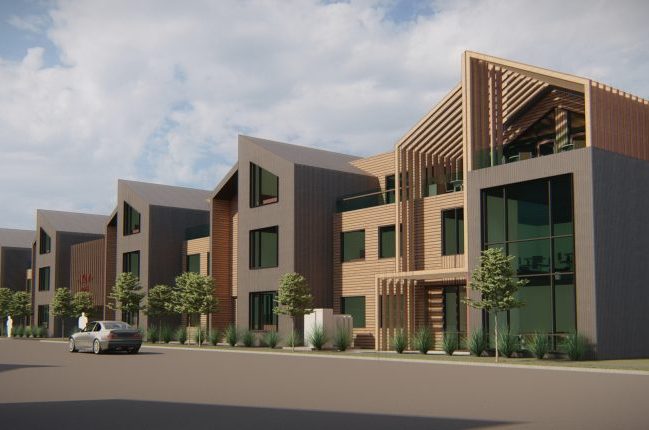
Three-storey apartment blocks will significantly help ease the housing crisis, says a major think tank. But unless there’s a re-think of strata law, it could be a disaster for owners say building surveyors.
A report this week by the Grattan Institute says housing developments of three-storey townhouses and apartments should be permitted on all residential land in all capital cities as part of a concerted policy assault on Australia’s housing crisis.
And it adds that blocks of six storeys or more should be allowed as-of-right around major transit hubs and key commercial centres.
However, it ignores one significant factor. In NSW at least, blocks of three storeys or less have few of the protections against dodgy developers that taller buildings have.
For instance, in three storey blocks, developers are allowed to vote on defect-related issues at AGMs. They are definitely not in higher rise buildings.
And in high-rises, an independent building inspector must be appointed – and they must be paid for by the developer – not in low-rise schemes.
None of which is even on the Grattan Institute’s radar when this week it spruiked the idea that low is the way to go.
Housing in Australia’s major cities is among the least affordable in the world, says the report, and restrictive planning controls add hundreds of thousands of dollars to the cost of new housing in our capital cities.
This is what the report says:
For decades, Australia has failed to build enough homes in the places that people most want to live.
Now we have a housing affordability crisis that is dividing families and communities and robbing young Australians of their best chance in life.
The key problem is that state and territory land-use planning systems say ‘no’ to new housing by default, and ‘yes’ only by exception.
About 80 per cent of all residential land within 30km of the centre of Sydney, and 87 per cent in Melbourne, is zoned for housing of three storeys or fewer. And three quarters or more of residential land in Brisbane, Perth, and Adelaide is zoned for two storeys or fewer.
The upshot is that our capital cities are among the least dense of their size in the world.
Allowing more housing in established suburbs would mean cheaper housing in all suburbs.
It would boost Australians’ incomes and quality of life, by letting more people live closer to high-paying jobs as well as transport, schools, and other amenities.
And it would mean shorter daily commutes and hence lower greenhouse-gas emissions.
Developments of up to three storeys that meet clear standards should not need a planning permit.
Larger developments that meet pre-set criteria should be assessed via ‘deemed-to-comply’ approval pathways.
Allowing three-storey townhouses and apartments on all residential land in capital cities would unlock commercially feasible capacity for more than one million new homes in Sydney alone.
Our modelling for this report shows that these reforms could lift housing construction across Australia by up to 67,000 homes a year, which over a decade could cut rents by 12 per cent and slice more than $100,000 off the cost of the median-priced home, and by much more in the longer term.
Australia needs a housing policy revolution. The equation is simple: If we build more homes where people most want to live, housing will be cheaper and our cities will be wealthier, healthier, and more vibrant.
Of course, the problem isn’t that low-rise developments are bad. It’s just that they are easy picking for dodgy developers.
“Any loophole creates opportunities for those looking to exploit regulatory gaps,” Sid Gokani, CEO of the Australian Institute of Building Surveyors (AIBS) told Flat Chat this week.
“If large low-rise buildings are exempt, operators will simply shift to different building classes to continue the same problematic practices. For this reason, AIBS supports uniform regulation across all building types.”
› Forums › Current Page
The Grattan Institute says low-rise blocks are the way to go – but they don’t know about the protections that they don’t have from dodgy developers.
[See the full post at: Think tank says go low – but Flat Chat says no]
If you want to be alerted when anyone replies to your posts or responds to this topic, please register and login, then you will be able to subscribe to the topic. The opinions offered in these Forum posts and replies are not intended to be taken as legal advice. Readers with serious issues should consult experienced strata lawyers. NB: Longer threads may spill over to additional pages - look for the numbers on the bottom right, under the last post.
› Forums › Current Page
› Forums › Current Page