
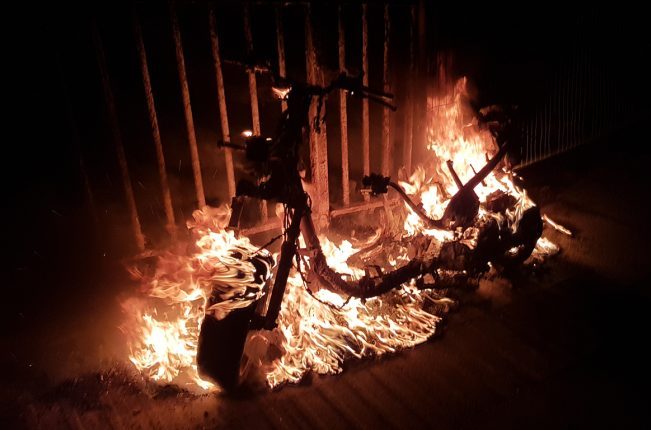
Apartment buildings across Australia are grappling with a question that literally could be one of life and death: how do you regulate something that is increasing in popularity, side-steps existing laws and could kill residents in your building?
While owners’ corporations and body corporates struggle to draft sensible and enforceable e-scooter and e-bike policies – or don’t even try because it’s too hard – lithium-ion battery fires are increasing at an alarming and accelerating rate across Australia.
Meanwhile e-scooter riders often blithely ignore the fact that their vehicles are illegal if they ride them in public (in some states) and many have little or no idea of the dangers they may pose to themselves or their neighbours, especially if they are damaged, mishandled or improperly charged.
And what has been described as a policy paralysis has gripped strata committees and strata managers alike, as they struggle to establish what they can do in terms of formulating enforceable by-laws that protect their communities.
Strata Community Association Queensland is now leading calls for urgent regulatory intervention, arguing that individual buildings cannot shoulder the burden of managing this crisis alone.
Queensland recorded at least six deaths from lithium-ion battery fires in 2025—compared with zero the previous year—yet many apartment buildings remain without clear rules about where these devices can be charged or stored.
According to SCA-QLD General Manager Laura Bos, the organization’s stance reflects growing alarm from strata managers who find themselves caught between legal uncertainty, enforcement challenges and genuine fear for resident safety.
“These are not abstract statistics. Behind every fire is a family, a building and a community left traumatised,” Ms Bos said. “The human cost, including young Queenslanders facing life-changing injuries and families grieving loved ones lost in preventable fires, reinforces the need for swift and coordinated responses.”
A National Crisis in Numbers
Queensland is far from the only state NSW experienced a staggering 95% increase in lithium-ion battery fires over just two years, from 165 incidents in 2022 to 272 in 2023 and 323 in 2024. Emergency services in NSW now respond to approximately 5.7 lithium-ion battery fires per week.
The human toll is mounting. NSW recorded its first two fatalities from lithium-ion battery fires in 2024, while Queensland’s six deaths in early 2025 suggest an alarming acceleration. By mid-February 2025, NSW alone had already confirmed at least 28 lithium-ion battery fires, with authorities responding to four separate incidents in a single 12-hour period in early February.
Internationally, the crisis appears even more severe. In the UK during 2024, fires involving e-bikes or e-scooters resulted in 8 fatalities and 86 non-fatal casualties across 211 incidents. New York City has emerged as a global hotspot, with e-bike-related fires in 2024 resulting in 6 deaths, 99 injuries, and 279 incidents.
Fire and Rescue NSW statistics indicate that people are four times more likely to be injured by a fire which originates from a lithium-ion battery compared to other fire types—a sobering statistic that underscores why SCA Queensland believes this issue demands immediate policy intervention.
Owners Corporations struggle
The challenge facing apartment buildings is multifaceted and unprecedented. Unlike traditional fire risks, which building codes and regulations have evolved to address over decades, e-scooter fires present a novel threat that existing frameworks were never designed to manage.
SCA Queensland reports that strata managers are hearing increasing concerns about unsafe charging practices, device modifications, and low-quality or second-hand e-scooters and e-bikes being stored and charged inside apartments and on common property. Yet translating these concerns into enforceable policies has proven extraordinarily difficult.
Owners’ corps face several interconnected obstacles. First, there’s the fundamental question of authority: do they have the legal power to regulate what residents do inside their private apartments? Can they prohibit charging devices overnight in bedrooms, or require residents to use only designated charging areas?
Second, enforcement presents a near-impossible challenge. How does a building manager verify that residents are using manufacturer-approved chargers? How can they identify modified batteries before they cause a fire? What recourse exists when residents simply ignore the rules?
Third, the liability question looms large. If a building implements policies but a fire occurs anyway, does that increase or decrease the body corporate’s legal exposure? What if the policies themselves are deemed inadequate or overly restrictive?
Ms Bos argues that these questions demonstrate why building-by-building responses are insufficient. “What we are seeing is a tragic and accelerating pattern that should alarm every Queenslander, particularly those living in strata communities,” she said. “Lithium-ion battery fires are fast, ferocious and often fatal. In apartment buildings they do not just endanger one household—they can place entire communities at risk.”
The Unique Vulnerability of Multi-Storey Buildings
SCA Queensland’s emphasis on strata environments isn’t merely organizational self-interest—it reflects genuine and distinctive risks that apartment buildings face.
The characteristics of lithium-ion battery fires make them particularly catastrophic in multi-storey residential settings. Authorities have warned that at-home modifications to lithium-ion batteries and related chargers had contributed to numerous fires, with investigators documenting cases where homemade charging systems caused batteries to overheat and explode.
Unlike conventional fires, thermal runaway events can reach temperatures exceeding 600 degrees Celsius within seconds. In apartment buildings with shared corridors, limited exit paths, and vertical air shafts that can spread smoke rapidly through multiple floors, a single e-scooter fire can trap dozens or even hundreds of residents.
The toxic gases produced pose an additional threat. One fire official noted that the gas released from lithium starting to undergo thermal runaway is extremely toxic and could kill occupants before flames even appear.
Recent incidents underscore these dangers. In July 2024, a lithium-ion battery from an e-bike exploded in a unit on the sixth floor of a 26-story building in Sydney, with seven people treated for smoke inhalation and 80-100 people evacuated. The building’s sprinkler system prevented a larger catastrophe, but the incident demonstrated how quickly a single-unit fire can endanger an entire building.
The Contributing Factors
SCA Queensland and fire authorities have identified several key drivers of the crisis that make policy development even more complex.
The proliferation of cheap, uncertified devices sold online represents perhaps the single largest challenge. Authorities believe low-quality e-bikes and e-scooters have contributed significantly to the rate of battery fires. Analysis by Allianz Insurance of 183 claims related to lithium-ion battery fires showed the majority involved e-bikes and e-scooters, caused by poor quality devices and poor charging practices.
The use of incompatible chargers compounds the problem. In March 2022, a Queensland man died from burns after a lithium-ion battery fire erupted in an e-scooter connected to an incompatible charger. The coroner ruled the death resulted from thermal runaway caused by the mismatched charger.
DIY modifications represent another significant risk. One fire official explained that when people modify scooters to increase power by arranging batteries differently, the batteries discharge faster than designed and cannot dissipate the resulting heat. A homemade power supply caused an e-bike battery to explode in Sydney’s Caringbah suburb when connected between a light fitting and the battery.
Consumer awareness remains shockingly low. The majority of e-bike owners (53%) and e-scooter owners (54%) are unaware their device is powered by a lithium-ion battery. This lack of awareness translates directly into dangerous behavior: nearly half of e-bike riders (49%) who charge at home are blocking their home’s fire exits.
What Some Buildings Are Attempting
While waiting for regulatory clarity, some forward-thinking apartment complexes have begun implementing their own solutions—though with varying degrees of success and legal certainty.
Measures being trialed include installing dedicated charging stations in well-ventilated common areas away from evacuation routes, implementing resident education campaigns about safe charging practices, drafting by-laws requiring devices to be charged only in designated areas, installing additional smoke detection in common areas where e-scooters are stored, and working with fire safety professionals to assess building-specific risks.
However, Ms. Bos emphasizes these ad-hoc solutions cannot substitute for comprehensive regulatory intervention. “Lithium-ion batteries behave very differently to traditional batteries. When they fail, fires can be sudden, intense and extremely difficult to escape from, especially in multi-storey residential buildings with shared corridors and limited exit paths.”
What SCA Queensland Is Demanding
The organization’s position has evolved from raising concerns to making specific, urgent demands of government and regulators.
SCA Queensland is calling for mandatory safety standards for all e-scooters and e-bikes sold in Australia—a position that aligns with regulatory action already underway in NSW. From February 1, 2025, all lithium-ion e-micromobility devices sold in NSW must comply with prescribed safety standards, with corporations facing fines up to $825,000 and individuals up to $82,500 for selling non-compliant products.
The organization also wants clear regulatory guidance for body corporates on what constitutes enforceable and legally defensible safety policies. Currently, strata managers operate in a grey zone where they risk either failing to protect residents or overstepping their legal authority.
Public education campaigns represent another key demand. “These deaths and life-altering injuries are not inevitable,” Ms. Bos said. “Many are preventable with better public education, safer products, the use of manufacturer-approved chargers only, and clearer guidance around where e-scooters and e-bikes should be charged and stored.”
Restrictions on the sale of uncertified batteries and chargers would address the root cause of many fires, while support for apartment buildings to install safe charging infrastructure would provide practical alternatives to bedroom and hallway charging.
A View from the Frontlines
The perspective SCA Queensland brings reflects not just policy analysis but frontline experience. Strata managers across Queensland are reporting near-daily conversations with worried residents, committee meetings dominated by safety concerns, and a growing sense that the regulatory response is lagging dangerously behind the scale of the threat.
“In strata environments, where one unsafe charging decision can place dozens or even hundreds of residents at risk, this issue goes beyond individual choice and becomes a shared safety concern,” Ms. Bos said.
The organization’s position reflects a fundamental argument: that apartment buildings should not bear sole responsibility for managing a product safety crisis that originates with manufacturers, importers, retailers and regulators.
SCA Queensland supports calls from fire authorities and affected families for stronger action, positioning itself alongside emergency services rather than in opposition. Fire and Rescue NSW has described lithium-ion batteries as the fastest-growing fire risk in the state—a characterization that SCA Queensland argues should trigger an emergency regulatory response.
The Path Forward
Ms. Bos acknowledges that perfect solutions remain elusive, but argues that imperfect action is preferable to continued paralysis. “We need urgent action from government, manufacturers, retailers and regulators. Body corporates shouldn’t be left to navigate this crisis alone, and residents shouldn’t have to wait for tragedy to strike their building before action is taken.”
The organization encourages continued scrutiny and welcomes discussion about practical solutions, but insists the time for purely consultative approaches has passed. With Queensland’s death toll already matching or exceeding entire previous years within just three weeks, SCA Queensland’s message is clear: apartment buildings are struggling to formulate effective e-scooter policies because they’re being asked to solve a problem that demands system-wide regulatory intervention.
Whether that message will translate into the swift regulatory action the organization is demanding remains to be seen. What’s certain is that with each passing week without meaningful policy response, more body corporates are left drafting rules they’re not sure they can enforce, to address risks they can barely quantify, for a crisis that shows no signs of slowing.
› Forums › Current Page
Misused e-bike and e-scooter batteries pose a real danger in homes, but how can strata schemes regulate their use to safeguard residents?
[See the full post at: Fatal inaction – call for e-bike strata regulations]
If you want to be alerted when anyone replies to your posts or responds to this topic, please register and login, then you will be able to subscribe to the topic. The opinions offered in these Forum posts and replies are not intended to be taken as legal advice. Readers with serious issues should consult experienced strata lawyers. NB: Longer threads may spill over to additional pages - look for the numbers on the bottom right, under the last post.
› Forums › Current Page
› Forums › Current Page